Thursday, March 24, 2011
"If I hadn't spent so much time studying Earthlings"
The aliens totally lack the understanding of free will, but are trying to understand it through humans. Billy is trying to help the aliens understand the behavior that they are witnessing but the aliens think the humans are bizarre creatures. When I think about this is makes me laugh that aliens think that humans are the bizarre ones; however when humans think about aliens we think of them as bizarre.
"God grant me the serenity to accept the things I cannot change, courage to change the things I can, and wisdom always to tell the difference"
The prayer on the wall shows that Billy has hope to keep going. The book also tells us that the framed prayer has also given his patients the hope to keep going on. Believing in something better than what your situation is at the time is enough to help someone take the next step. Someone believing in you gives you this security that nothing else can give you and I truly believe that is what the prayer gave Billy and others who encountered it.
"Billy could almost smell his breath-mustard gas and roses"
Vonnegut is smelling the mustard gas which symbolizes poisoning; however he also smells the roses which is symbolizing romance. Both of these elements are key way to see how the war is directly affecting Vonnegut's everyday life. He is on the telephone and yet he feels as if he is able to smell these smells through it. In reality this is a very sad but serious problem that the war does to people. Even know a days when people come home from battle they are not the same and they replay what they went through.
Publication

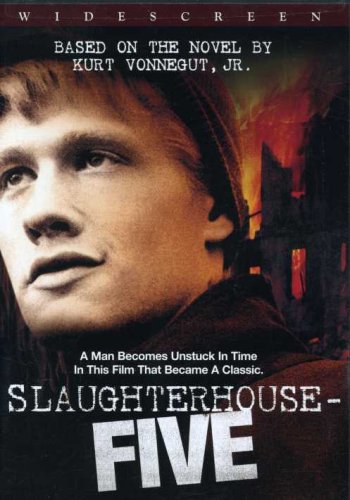
Slaughterhouse Five, is a science fiction novel by Kurt Vonnegut about WWII experiences and journeys through time of a solider called Billy Pilgrim. Vonnegut published Slaughterhouse Five in 1969.
Other Books Vonnegut Published:
Player Piano (1952)
The Sirens od Titan (1959)
Mother Night (1961)
Cat's Cradle (1963)
Slaughterhouse Five (1969)
Breakfast of Champions (1973)
Kurt Vonnegut
Writer, novelist. Born on November 11, 1922, in Indianapolis, Indiana. Kurt Vonnegut is considered one of the most influential American novelists of the twentieth century. He blended literature with science fiction and humor, the absurd with pointed social commentary. Vonnegut created his own unique world in each of his novels and filled them with unusual characters, such as the alien race known as the Tralfamadorians in Slaughterhouse-Five (1969).
He was a student at Cornell University from 1940-1942. After he finished school Vonnegut enlisted the U.S. Army. He was captured as a POW in Dresden, Germany. Kurt escaped unharmed because he was in a meat locker when Dresden was bombed. Not long after the war Kurt married his High School Sweetheart, Jane Marie Cox. Vonnegut had multiple jobs before his writing career started, including public relations employee for General Electric, teacher, and newspaper reporter.
Sunday, January 9, 2011
1972: Write an essay about the opening scene of drama or the first chapter of a novel in which you explain how it functions in this way
In the novel Going After Cacciato, Tim O'Brien first starts by telling you a brief update on what is going on at the platoon and then introduces the main idea of the story line. The first chapter is clearly setting up the rest of the novel to elaborate on. In this scene Tim O'Brien tells about Cacciato and his encounter with Paul Berlin and then fast forwards to Cacciato running away and Berlin trying to remember exactly where Cacciato said he always wanted to go.
Lt. Corson tells the platoon about the mission; going after Cacciato and they disagree. All the soldiers think that Cacciato is dumb because he is always grinning, whistling, and chewing gum therefore; they do not want to go look for him. However; Lt. Corson decides that the soliders will pursue the mission and bring Cacciato back.
Berlin then remembers how Cacciato would spend hours day looking at maps, and asking questions about mountains, planning out this trip. Berlin can not remember all the places that Cacciato says that he would go through but he could remember a few. The squad then sets out to catch Cacciato.
Cacciato is then sighted many times throughout the first chapter but he is never caught. Cacciato even sets out smoke bombs; which makes the troops very upset, to see if anyone was behind him. The end of the chapter leaves you wanting to know more. It tells you at Berlin is instructed to fire a green flare and then the squad moves in to capture Cacciato. The structure of this novel sets up the a major theme and then makes it where you have to read the rest to know what happends.
Lt. Corson tells the platoon about the mission; going after Cacciato and they disagree. All the soldiers think that Cacciato is dumb because he is always grinning, whistling, and chewing gum therefore; they do not want to go look for him. However; Lt. Corson decides that the soliders will pursue the mission and bring Cacciato back.
Berlin then remembers how Cacciato would spend hours day looking at maps, and asking questions about mountains, planning out this trip. Berlin can not remember all the places that Cacciato says that he would go through but he could remember a few. The squad then sets out to catch Cacciato.
Cacciato is then sighted many times throughout the first chapter but he is never caught. Cacciato even sets out smoke bombs; which makes the troops very upset, to see if anyone was behind him. The end of the chapter leaves you wanting to know more. It tells you at Berlin is instructed to fire a green flare and then the squad moves in to capture Cacciato. The structure of this novel sets up the a major theme and then makes it where you have to read the rest to know what happends.
Saturday, January 8, 2011
"I guess it's better this way. There is worse things that could happen. There is plenty of worse things"
This whole book is so uplifiting. I haven't ever read a war story and the characters be so upbeat and always looking for all the postive. Even though they are in war and things aren't going the way that they would have hoped, they are still seeing that it could be worse. Personally, I find this quote along with the rest of the book simplu amazing.
Subscribe to:
Posts (Atom)


